We understand the unique pressure event planners and site managers face when coordinating high-end outdoor events. Guests at upscale weddings hold higher expectations for every touchpoint. A standard portable unit simply does not fit the design profile of a private US estate hosting 200 formally dressed attendees.
Our team at Porta Johns for Rent has seen how basic porta potties clash with a $50,000 floral budget or a custom-built clear top tent.
The solution is the restroom trailer. Let’s review the logistics, power requirements, and sizing strategies required for a flawless wedding restroom trailer rental setup.
Why upscale weddings choose trailers over porta potties
Upscale weddings require restroom trailers because standard porta potties cannot match the comfort or aesthetic of a luxury event. The average US wedding cost now hovers around $36,000 based on 2026 data from Zola and The Knot.
We know that modern couples spend a massive portion of that budget on visual design and photography. A portable toilet with a chemical smell instantly ruins that carefully curated vibe. Industry data shows that guest complaints about long lines and unsanitary conditions will overshadow an otherwise perfect reception.
Our premium wedding bathroom trailer bridges the gap between rugged outdoor logistics and five-star hospitality. Here are three distinct reasons this upgrade is strictly required for high-tier budgets:
- Guest experience matches the rest of the wedding. A high-budget event with basic units feels completely disjointed. Guests notice this discrepancy immediately. Photos and reviews suffer. A trailer brings the restroom in line with the rest of the production.
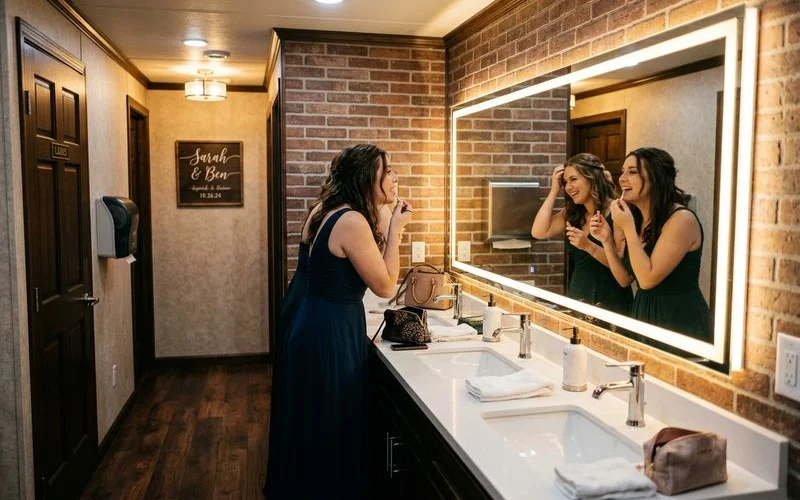
- The wedding party uses the trailer differently. Bridal party touch-ups, groomsmen suit changes, and late-ceremony emergencies need actual mirrors, significant space, and running water. A standard portable unit fails to support this activity. A spacious trailer handles it perfectly.
- Older guests and accessibility needs are addressed. Parents, grandparents, and guests with limited mobility use the trailer comfortably. Standard units present a severe trip hazard and lack adequate handrails. A trailer equipped with at least one ADA-compliant stall fully covers this accessibility mandate.
Common wedding venues
Four specific venue types drive the majority of luxury trailer bookings across the United States. These outdoor locations typically lack the permanent plumbing required to handle the surge of 150 or more guests.
We regularly coordinate with site managers across these four primary categories to guarantee proper placement and power access. Proper planning prevents overloaded septic systems at historic sites. Each property type presents a unique set of logistical challenges:
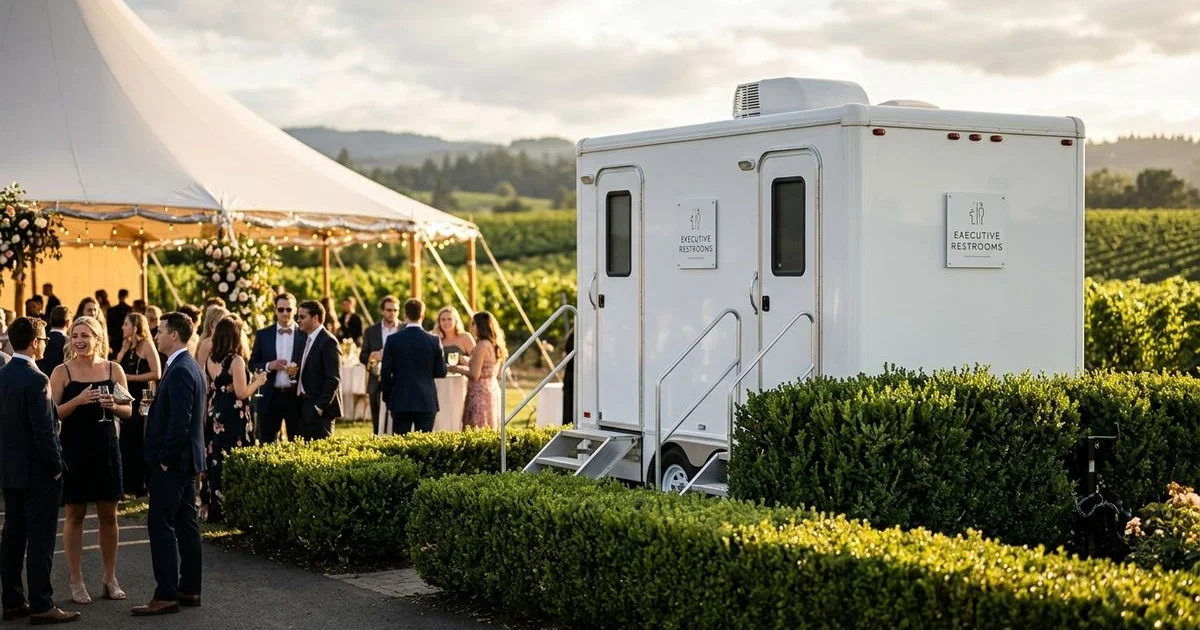
- Vineyards and wineries. Popular regions like the Carolina Piedmont feature stunning outdoor spaces with no permanent restrooms nearby. Securing a vineyard wedding restroom rental usually means positioning the trailer behind decorative vines. You will need a standard water spigot within 100 feet to fill the 105-gallon fresh water tanks.
- Barns and farm venues. Traditional rustic venues often have a single small restroom near the main building. That solitary restroom cannot handle peak-use volume safely for guest counts exceeding 100 people. Trailer placement usually occurs adjacent to the barn in a screened-off area.
- Private estates and gardens. Rented private estates possess limited interior residential plumbing that should not be overwhelmed. Planners usually place the trailer 50 to 100 feet from the reception. You must ensure access to a dedicated 20-amp, 110-volt electrical outlet to power the air conditioning.
- Beach and outdoor open-air venues. These raw coastal spaces offer zero permanent facilities. Trailer placement happens on level, compacted ground at the edge of the event footprint. The delivery team usually spots the unit near the access road.
Most wedding planners understand these placement rules intuitively based on past events. This baseline knowledge keeps the planning process moving quickly.
Our field representative always walks through the site before delivery for first-time placement at a new venue. This in-person or photo-based site check prevents delivery day delays. It guarantees the truck has enough clearance to maneuver safely.
Aesthetic placement matters
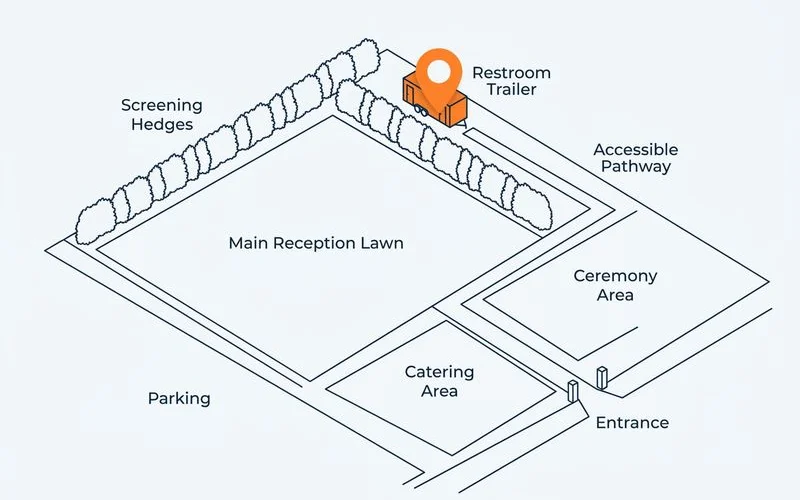
A trailer that looks out of place disrupts the entire event design and draws unwanted attention. Proper placement keeps the facility discreet while remaining highly accessible for attendees.
Our team recommends treating the unit like any other architectural feature that requires careful staging. Event coordinators must balance hidden placement with a maximum walking distance of 75 feet from the main tent. A unit placed too far away creates a frustrating experience for guests wearing formal footwear.
Three placement rules ensure a discreet setup:
- Screen from main reception sight lines. Use existing vegetation, hedge walls, or temporary screening like lattice panels. The trailer should be findable but never serve as a visual focal point.
- Light the path, not the trailer. Path lighting from the reception to the trailer should use subtle lanterns or string lights. The exterior of the trailer itself should not be harshly uplit.
- Provide directional signage that matches the wedding aesthetic. Custom signage printed on the wedding’s stationery base keeps the design cohesive.
Trailers can be effectively invisible to most guests until they need them. This invisibility is the hallmark of excellent event flow.
We train our installation crews to position the entry doors facing away from the primary dining area. This small adjustment blocks interior light from spilling into the reception space at night. It makes a massive difference in the final event photography.
Guest-count sizing for weddings
Proper sizing guarantees short wait times and prevents the internal waste tanks from reaching capacity mid-event. Event managers must match the stall count to both the attendee total and the beverage menu.
We constantly remind planners that a typical 2-stall unit utilizes a 200-gallon waste tank. This standard tank provides roughly 100 to 150 uses before requiring a pump service. When weddings feature an open bar, restroom usage jumps significantly.
Here is a starting reference for US wedding sizing:
- 50-150 guests, 4-6 hours: 2-stall trailer (1 men / 1 women).
- 150-250 guests, 4-6 hours: 3-stall or 4-stall trailer if alcohol-heavy.
- 250-400 guests, 4-6 hours: 4-stall trailer (2 men / 2 women) equipped with a 300-gallon tank.
- 400-600 guests: 4-stall plus standalone ADA portable toilet, or an 8-stall trailer.
- 600+ guests: 8-stall trailer with optional standalone ADA add-ons.
Weddings with heavy alcohol service push sizing up by one full configuration tier. Multi-day events like a rehearsal dinner, ceremony, and Sunday brunch sometimes use a smaller trailer for shoulder events and a larger unit for the main reception.
Our logistics team can swap units overnight to ensure pristine conditions for each gathering. For complete capacity formulas, see our guide on choosing restroom trailer size.
ADA stalls for wedding events
Every wedding must carefully consider accessibility to ensure all attendees can safely navigate the venue. Event managers must understand the specific rules that govern temporary restroom compliance in the US.
Our experience shows that many planners accidentally rent a standard unit under the assumption that it covers mobility needs. Private weddings on private property are actually exempt from ADA Title III regulations. Weddings at public-accommodation venues like rented country clubs or historical sites strictly require ADA-compliant facilities.
True ADA accessibility requires specific hardware, including a specialized entry ramp with a maximum 1:12 slope. We strictly verify that our specialty units meet the mandatory 60-inch internal turning radius for wheelchair users. Three approaches solve this requirement:
- ADA-configured trailer. This unit features a hydraulic lowering system to create ground-level access, wider stalls, and the mandatory 60-inch turning radius.
- Mixed-stall trailer. This configuration combines 1-2 ADA stalls with standard stalls in one large unit. Mid-size weddings often choose this route.
- Standard trailer + standalone ADA portable toilet. The main guest population utilizes a standard trailer, while a standalone ADA-compliant stall sits nearby.
Your assigned project manager will recommend the right approach based on venue specifics and the guest mix.
Lead times
Securing a premium restroom trailer requires booking six to nine months in advance for the busy peak season. Inventory for specialty setups vanishes quickly.
We tell all our clients that the US wedding boom now heavily favors late summer and early fall. September and October currently rank as the most popular months to get married. Event planners must secure contracts immediately after finalizing the venue.
Our dispatch team sees premium 4-stall units and ADA-configured trailers fill up first. Off-peak dates from November through April usually book within 2-4 weeks. Trending Tuesday-Thursday celebrations also offer more flexibility.
Here is a breakdown of expected booking windows:
- Peak Season (May-October): Event planners must secure contracts 6-9 months ahead.
- Off-Peak (November-April): Weekday weddings and winter dates usually book within 2-4 weeks.
- Last-Minute Requests: Requests under 2 weeks create significant logistical strain and limit your configuration choices.
Our system holds the exact requested unit in our inventory the moment a deposit clears. This guarantee eliminates the stress of delivery day substitutions. You can cross this major task off your planning checklist permanently.
Booking process
The booking process moves from an initial capacity consultation to a finalized reservation in under 24 hours. A dedicated representative manages every technical detail required for a successful installation.
We simplify the administrative work so you can focus on the catering and floral design. The standard wedding booking flow follows a strict timeline:
- Initial conversation. Discuss the venue, guest count, date, and any specific requirements like an onboard generator or attendant.
- Quote generation. A custom quote arrives within hours, including delivery, setup, and pickup. You will not find hidden fuel surcharges.
- Deposit and reservation. Inventory holds firm against the booking.
- Pre-event coordination. Your rep confirms delivery timing, 20-amp electrical hookup needs, and a 100-foot water source directly with the venue manager.
- Delivery and testing. The trailer arrives the day before or the morning of the event. Technicians deploy stabilizers, fill the 105-gallon freshwater tank if needed, and confirm all power hookups.
- Optional on-site attendant. For premium weddings, a service attendant maintains the trailer through the reception.
- Pickup. The driver collects the trailer the next business day after the event. No cleaning is required on your side.
This smooth workflow prevents miscommunication between the rental company and the property owner. Our delivery crews handle the heavy lifting while you manage the rehearsal dinner. Every unit arrives fully stocked with premium paper products and hand soap.
The installation team walks through a final inspection with the venue point of contact to verify everything operates correctly.
Cost framing
Expect to allocate between $1,200 and $2,500 for a standard luxury restroom trailer rental in the United States. When a couple spends over $34,200 on their total wedding, this small budget percentage delivers massive returns in guest comfort.
Our pricing structure remains fully transparent with no surprise delivery fees. A standard 2-stall trailer for a weekend wedding starts around $1,200. A spacious 4-stall unit starts around $2,000.
We note that ADA-configured and 8-stall trailers price higher due to their complex delivery requirements. Add-ons like an ultra-quiet 60-decibel generator, an auxiliary freshwater tank, or premium servicing scale the total invoice. The cost-per-guest actually drops significantly as the guest count climbs.
Our data shows the value scales clearly across different event sizes:
- 100 Guests: A $1,200 trailer averages $12 per head.
- 200 Guests: A $2,000 trailer averages $10 per head.
- 300 Guests: A $2,100 trailer breaks down to just $7 per head.
At that scale, the trailer becomes an objectively superior value compared to renting dozens of standard plastic units. The investment pays back immediately in superior guest experience and pristine photo quality.
Conclusion
Executing a high-end outdoor event requires flawless logistics and premium amenities. A luxury mobile unit ensures your attendees never compromise their comfort.
Our team guarantees a wedding restroom trailer rental that exceeds the expectations of the most discerning guests. Contact the dispatch desk today to reserve the perfect unit for your upcoming date. Your client’s perfect day deserves the perfect infrastructure.