We know sanitation directly impacts your job site or public event.
Poorly scaled facilities create bottlenecks. These delays frustrate crowds and slow down work crews.
Our team relies on three core metrics for sizing. Total attendance, event duration, and peak usage concentration dictate the necessary capacity. This restroom trailer size guide maps those variables directly to stall configurations.
We also maintain a separate guide strictly covering wedding-specific sizing for private events.
Let’s look at the baseline math. We will cover the adjustments required by law and the pacing multipliers that prevent long lines.
Guest-count thresholds by configuration
We always start with baseline configurations before adjusting for duration or alcohol. The standard formula provides one stall for every 125 attendees at a four-hour gathering.
Construction managers must also factor in OSHA 29 CFR 1926.51 requirements. The federal standard mandates one toilet and one urinal per 40 workers on sites with 20 to 200 employees.
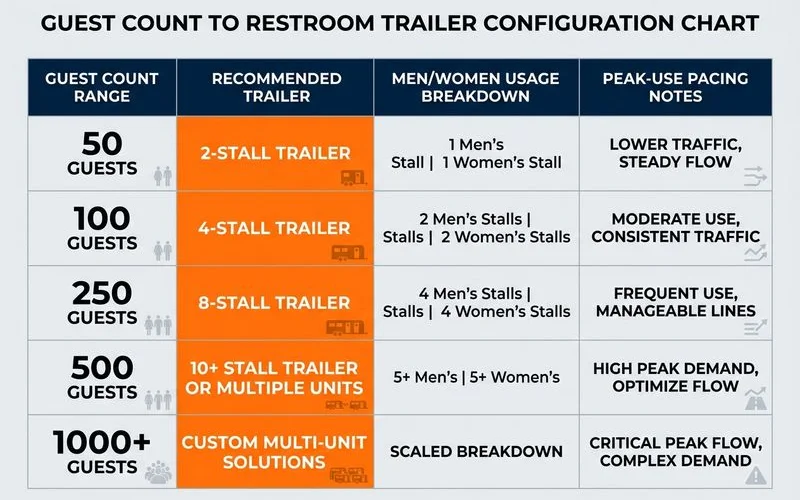
Our restroom trailer stall count recommendations break down into these common categories.
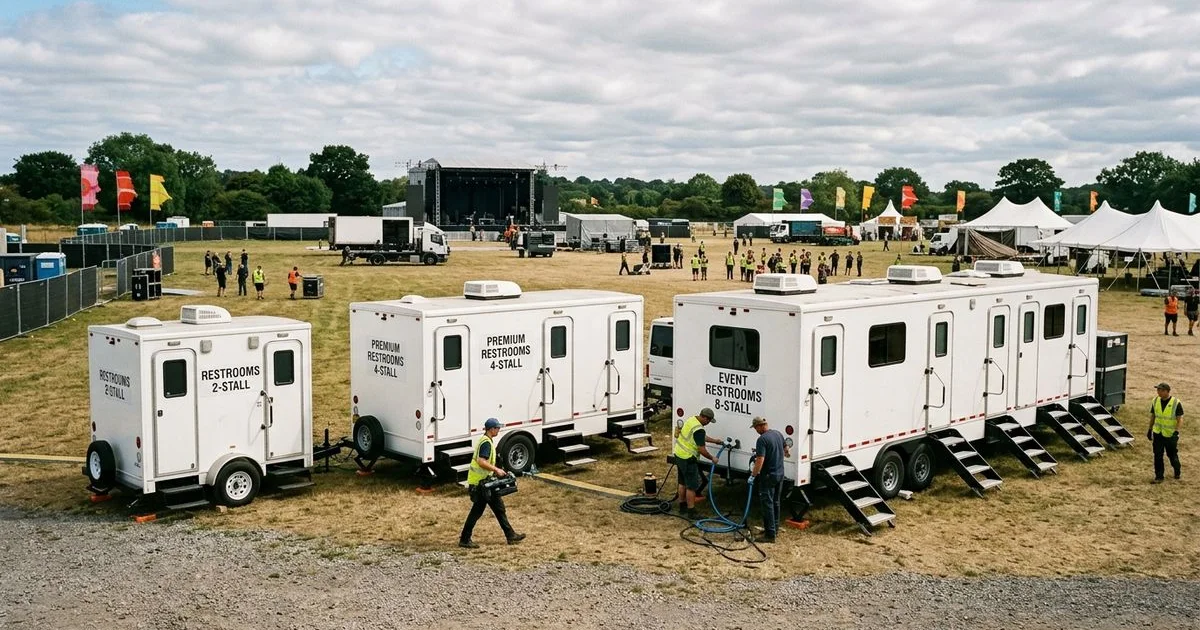
- 2-stall trailer (1 men / 1 women). Serves up to 250 guests for 4 to 6 hours. This is the most common configuration for intimate corporate events and limited-crew construction zones.
- 4-stall trailer (2 men / 2 women). Serves up to 500 guests for 4 to 6 hours, or 250 guests for alcohol-heavy events. Mid-size municipal gatherings, corporate events, and small festivals rely on this size.
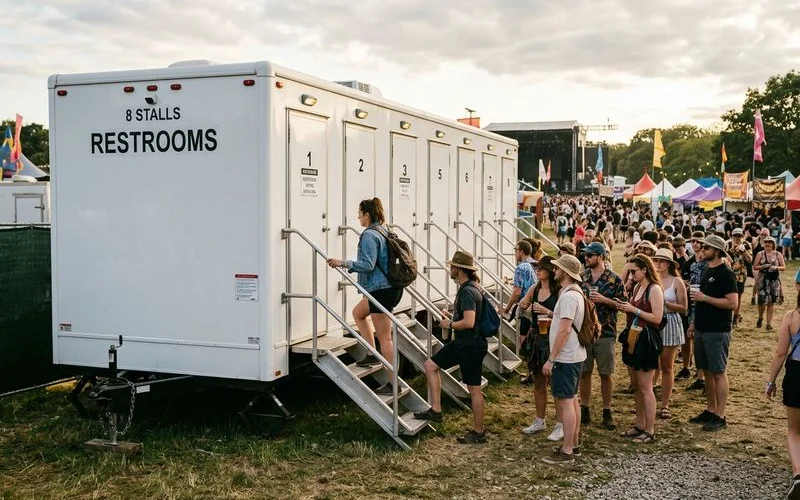
- 8-stall trailer (4 men / 4 women). Serves up to 1,200 guests for 4 to 6 hours. Large multi-day events, municipal festivals, and high-attendance corporate functions require this volume.
Mixed-stall trailers combining standard and ADA stalls typically follow the same guest-count math as their total stall count.
Men/women stall breakdown rules
Standard trailer configurations split men’s and women’s stalls evenly. This equal split serves general public events perfectly.
We regularly adjust this ratio based on the specific demographic makeup of the crowd. Wait times for women average roughly one minute and thirty seconds longer per use.
Stall doors, clothing adjustments, and the lack of urinals create this difference. That time disparity causes immediate queues if the ratios remain unbalanced.
Our standard adjustments for gender ratios include the following approaches.
- Events with majority female attendance: Plan for women’s stalls at 60 to 70 percent of the total. Asking your representative to flex the configuration prevents major backups at bridal events or baby showers.
- Events with majority male attendance: Flip the logic to favor men’s facilities. Sports tournaments and heavy industrial job sites benefit from higher urinal counts.
- General-public events: A standard 50/50 split with an even stall count works best for festivals and mixed-attendance functions.
The women’s-stall constraint binds first at most gatherings because of those longer average use times. Sizing calculations must treat the women’s capacity as the limiting factor.
Event-duration impact on sizing
Sizing math assumes a 4 to 6 hour timeframe. Longer shifts or full-day festivals require a proportional increase in capacity.
We scale up the stall count to compensate for the waste tank limits and continuous traffic. Extended durations quickly overwhelm standard setups.
Here is the standard capacity adjustment based on time.
| Event Duration | Capacity Adjustment Required |
|---|---|
| 4 to 6 hour event | Standard sizing per the guest-count thresholds |
| 6 to 8 hour event | +15 to 20 percent capacity (jump to next stall tier if close) |
| 8 to 12 hour event | +30 percent capacity (next stall tier definitely) |
| Multi-day event (24+ hours) | 2x sizing minimum to account for sustained use |
Our crews also require designated servicing windows built into the event plan for any multi-day schedule. Vacuum-truck servicing typically happens during low-use hours to pump tanks and restock supplies.
ADA addition: when to add, mixed-stall vs dedicated
ADA stalls are not part of the standard trailer math. These accessible units add to the overall sizing rather than substituting for standard stalls.
We strictly follow the 2010 ADA Standards for Accessible Design. The federal law mandates that at least five percent of portable units in a single location must be accessible.
Public-accommodation events require clear 60-inch turning radiuses and flat floor entries to meet Title III regulations. Planners have three primary approaches to achieve compliance.
- Dedicated ADA trailer. This separate trailer features fully ADA-compliant stalls. Large public events, federal projects, and sites undergoing detailed compliance reviews use this option.
- Mixed-stall trailer. A single trailer combines standard and ADA stalls into one footprint. Mid-size corporate events and municipal gatherings commonly use this layout.
- Standalone ADA portable toilet paired with standard trailer. This lower-cost alternative works for sites where ADA demand is moderate. It prevents over-specifying a full ADA trailer while maintaining compliance.
Our experience shows that providing accessible units is highly recommended even on private property. Elderly guests or individuals with hidden mobility needs always appreciate the wider doors and grab bars.
Peak-use pacing
The standard timeframe assumption hides a major variable. The concentration of peak use during specific windows changes everything.
We calculate a higher stall requirement for events where the entire crowd needs the restroom simultaneously. Smooth-use events spread the demand evenly.
Staggered corporate dinners or ceremonies flow well, so standard sizing applies. Concentrated-use events compress that demand into 30 to 60 minute windows. Cocktail hours and intermission rushes cause sharp spikes.
Concentration Multipliers
Certain elements drastically alter bathroom frequency. Alcohol acts as a diuretic by inhibiting a natural antidiuretic hormone.
This biological reaction increases urine production significantly and requires a capacity boost.
- Alcohol service: Peak use comes earlier and lasts longer, requiring a 15 to 30 percent sizing increase.
- Single-meal events: The post-meal peak is sharp, demanding a 10 to 15 percent capacity bump.
- Outdoor summer events: Heat drives hydration. This leads to more frequent use and requires 10 percent more capacity.
- Family events with young children: Shorter use intervals dictate a 10 percent increase in facilities.
We advise planners to bump up to the next trailer size tier if their schedule includes two or more of these multipliers. Accepting brief queue times is an option, but adequate facilities keep attendees much happier.
Sample sizing for common events
Real-world applications make these ratios easier to visualize and plan for. We build custom quotes every day using these exact formulas across different industries.
A standard 200-guest gathering with a 5-hour reception and alcohol service requires a 2-stall trailer. This unit features 1 men’s and 1 women’s stall.
Planners should add 1 standalone ADA portable toilet if the venue falls under public-accommodation rules.
Construction and Corporate Sites
A 500-guest corporate event lasting 6 hours with alcohol needs a 4-stall trailer. A mixed-stall 4-stall trailer with 1 ADA and 3 standard units satisfies both volume and compliance.
Our guidelines for a 1,000-guest single-day festival lasting 8 hours include heavy supplementation.
- 8-stall trailer (4 men / 4 women) as the primary hub
- 2 to 3 standalone ADA portable toilets distributed across the venue
- 20 to 30 standard porta potties for general admission areas
- Handwash stations placed at a ratio of 1 per 10 porta potties
Multi-Day Festival Setup
A 1,500-guest multi-day festival spanning three days demands a massive infrastructure scale up. Planners will need two 8-stall trailers or one dedicated ADA trailer paired with a standard 8-stall unit.
The grounds will also need 40 to 60 standard porta potties. You must include at least 4 standalone ADA portable toilets and multiple handwash stations.
Servicing must be scheduled twice daily to maintain sanitary conditions.
What to ask your commercial rep
Accurate sizing requires a detailed conversation about the specific variables of your project or gathering. We need to know the exact logistics to provide a quote that guarantees adequate capacity without overspending.
Your representative will walk through a specific checklist. Having this data ready speeds up the reservation process.
- Total expected guest or worker count
- Event duration in both hours and consecutive days
- Whether alcohol will be served on the premises
- Whether the venue is public-accommodation requiring ADA compliance
- Guest demographics, such as family-heavy crowds versus adult-only
- Hookup availability for 110v/30amp power and freshwater
- Whether premium configurations like attendants or generators are required
Our team takes this information and returns a quote with the right stall count. The proposal includes any optional add-ons.
Quotes are custom-built for each location and completely free of charge.
Lead-time considerations by configuration
Inventory availability fluctuates wildly depending on the requested stall count, ADA configuration, and the time of year. We strongly advise securing your reservation the moment your date and venue are locked in.
Supply chain constraints and seasonal demand spikes make early booking critical for larger units. Here are the current lead times for 2026 rentals.
| Configuration Type | Peak Season Lead Time | Off-Peak Lead Time |
|---|---|---|
| 2-stall standard | 4 weeks ahead | 2 weeks ahead |
| 4-stall standard | 4 to 8 weeks ahead | 2 to 4 weeks ahead |
| 8-stall standard | 6 to 12 weeks ahead | 4 to 6 weeks ahead |
| ADA configurations | 6 to 12 weeks ahead | 4 to 6 weeks ahead |
A simple deposit holds the inventory for your specific dates. Waiting until the final month almost guarantees that specialized equipment will be rented out elsewhere.
Conclusion
Figuring out what size restroom trailer you need does not have to be a guessing game. We hope this restroom trailer size guide gives you the exact math needed to plan a successful project or gathering.
Proper stall count calculations keep lines short and protect site hygiene. These formulas also ensure total compliance with federal regulations.
Reach out to our team today. Discuss your next big event and secure your specialized sanitation equipment.