As contractors and event planners, accessibility is often treated as an afterthought. That mistake can trigger costly delays and frustrated guests.
Our crews know that ADA portable toilets are not optional at public events across the US.
ADA Title III sets strict federal requirements for these facilities. Event venues, permit reviewers, and county compliance teams constantly check these numbers.
We typically start the calculation at 5 percent when clients ask how many ada porta potties per event they need to order. Let’s look at the data, break down the specific rules for different event types, and explore exactly how to place these units for full compliance.
The 5% rule of thumb: How many ada porta potties per event?
For most public events in the US, you must dedicate at least 5 percent of your total portable toilet inventory as ADA-compliant. The 2010 ADA Standards for Accessible Design also mandate a minimum of one accessible unit per logical cluster.
Our team uses this baseline to keep job sites and festivals fully compliant. The math works out quite simply depending on your crowd size.
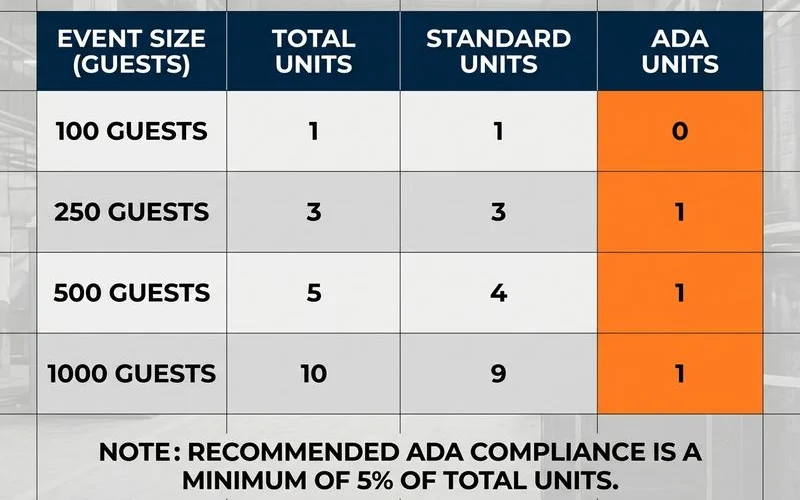
- 20-guest event: 1 ADA unit to meet the minimum cluster rule.
- 100-guest event: 1 ADA unit representing 5 percent of 3 to 4 standard units.
- 250-guest event: 1 to 2 ADA units.
- 500-guest event: 2 to 3 ADA units.
- 1,000-guest event: 4 to 5 ADA units, distributed across cluster locations.
- 5,000+ guest festival: 10 to 15 or more ADA units across multiple clusters.
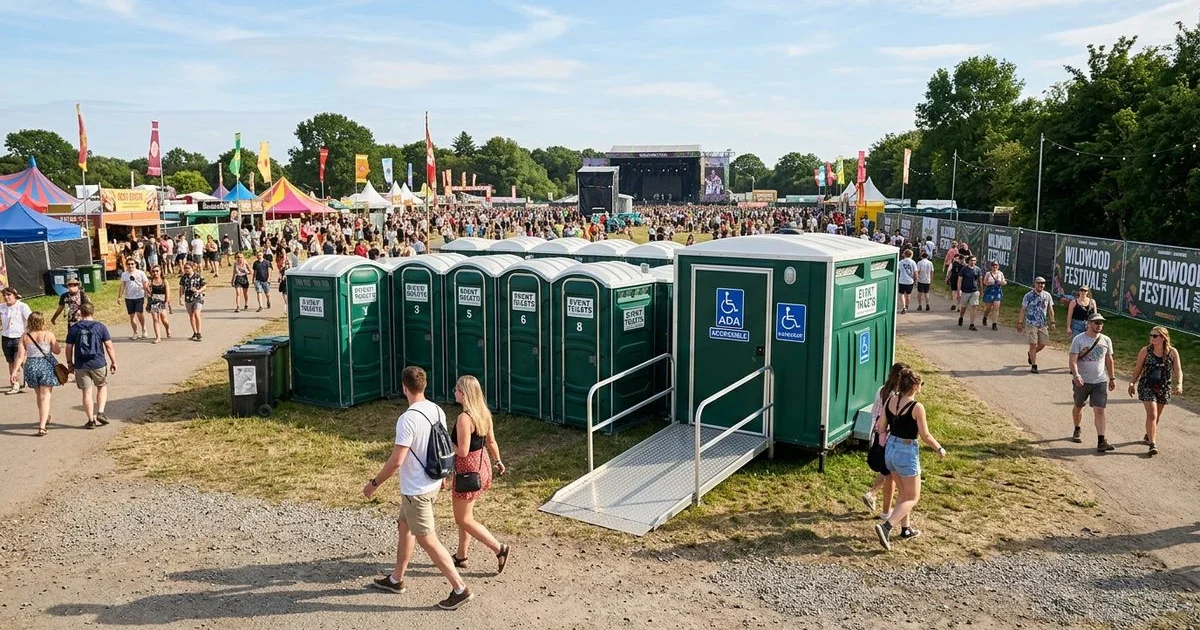
If your event features multiple toilet clusters in different zones like the main stage or parking area, each separate location requires its own accessible unit.
We always remind clients that failing this cluster rule is a common trigger for failed inspections. A single accessible unit at the main gate does not cover a secondary cluster near the food trucks.
Where the special-case rules kick in
The standard 5 percent ada porta potty ratio serves as a regulatory floor, but several specific event types require a much higher count. Certain high-traffic situations demand extra accessible capacity to serve the public effectively.
Our project managers recommend adjusting your math for the following scenarios to avoid long lines.
Festivals and outdoor music events
Multi-day events with high alcohol service keep guests on-site for longer durations. Planners should aim for 7 to 10 percent accessible inventory in these environments.
We have found that placing these units in highly visible, clearly signed locations prevents frustrated attendees.
Sports tournaments and youth athletic events
Parents and older family members are often the largest accessibility user group at athletic events. The athletes themselves might not need accessible facilities, but the broader spectator audience absolutely does.
Our teams advise a 5 to 7 percent ratio with clearly signed units near bleachers and viewing zones.
Ticketed public weddings
Vineyard ceremonies, barn weddings, and any venue open to the public require compliance with the standard 5 percent rule. Private weddings on private property might seem exempt at first glance.
We remind property owners that the moment a venue rents to non-members or sells public access, Title III regulations immediately apply. The legal distinction rests entirely on public accommodation status.
Disaster relief and public response staging
State agencies and FEMA require accessible inventory in every single staging area, not just the main intake points. Emergency guidelines often push the required inventory up to 10 percent to accommodate displaced individuals with varying mobility needs.
Our emergency response crews always verify exact counts with the lead agency coordinator before deployment.
Public works and municipal projects
Title III public accommodation rules remain active throughout a project lifecycle, not just on opening day. Permit reviewers actively reference these standards during routine site inspections.
We always supply accessible facilities for both workers and any public visitors walking around the site. Proper ada title iii event compliance protects your project timeline from unexpected stop-work orders.
Placement matters as much as count
The 5 percent calculation dictates your order volume, but physical placement determines if you actually pass inspection. You must position units on flat, stable ground with a clear, accessible path of travel.
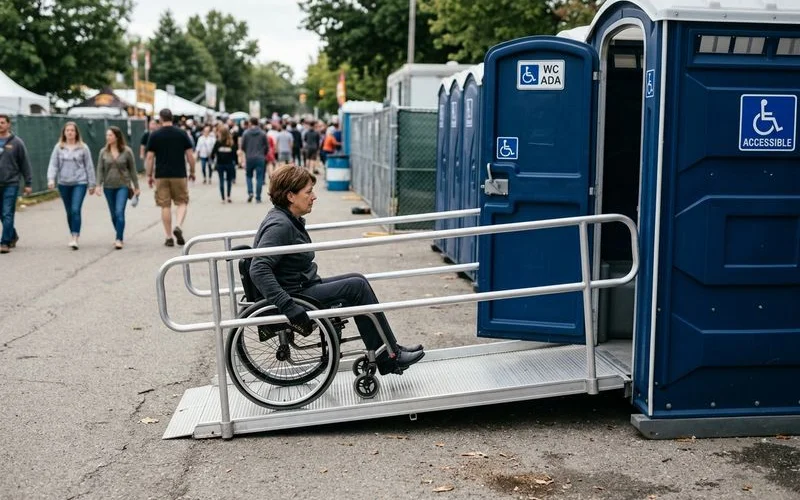
Our delivery drivers frequently correct placement errors that would otherwise result in heavy fines. Title III regulations require a 60-inch interior turning radius and a 32-inch clear door opening, which means the surrounding exterior must support easy wheelchair access.
Here are three critical placement rules to follow:
- Distribute across clusters. Do not isolate all accessible units in one remote corner of the venue. If your layout features four distinct restroom banks, each bank needs at least one accessible toilet.
- Sign clearly. Accessible units require clear signage visible from all approach paths. Standard International Symbol of Accessibility iconography on the door meets this requirement.
- Maintain accessible paths. The route from a spectator zone to the facility must feature a firm surface without abrupt grade changes or obstructions.
A perfectly sized order placed on a muddy incline fails compliance just like an undersized order.
We have seen permit reviewers flag both scenarios and trigger formal complaints against the venue. Proper ground assessment prevents these costly mistakes.
Mixed-fleet sample for events
Combining premium restroom trailers with standard portable units is the most effective way to handle large crowds. This mixed-fleet approach balances high-end VIP needs with general admission volume requirements.
Our logistics team frequently builds out sites using this specific deployment pattern. This setup handles most mid-to-large events without requiring heavy customization.
| Fleet Component | Primary Location | Recommended Sizing |
|---|---|---|
| Restroom Trailers | Premium and VIP areas | Sized by crowd, includes 1 to 2 accessible stalls |
| Standard Portable Toilets | General admission | Based on total expected guest count |
| Standalone Accessible Units | Distributed across general clusters | Minimum 5 percent of standard count |
| Handwash Stations | Next to all standard toilet clusters | 1 station per 2 to 3 standard units |
OSHA 29 CFR 1926.51 regulations also heavily emphasize handwashing stations for worker safety, making them a crucial add-on.
We always include adequate wash stations to keep sites sanitary and compliant. Clean hands reduce the spread of illness across your entire workforce or guest list.
What to ask your commercial rep
Providing accurate event details to your commercial representative guarantees a compliant and cost-effective sanitation plan. The right questions ensure you order the exact mix of standard and accessible units required for your specific region.
Our customer service specialists will need to know a few key details to build your accurate quote.
- Total expected guest count and peak attendance hours.
- Total event duration, including setup and teardown days.
- Whether the event includes alcohol service, which increases usage by up to 30 percent.
- Whether the venue is a ticketed public space or a private property.
- Whether you plan to have multiple cluster locations across the grounds.
- Whether you prefer accessible restroom trailers or standalone plastic units.
The final quote comes back built for your exact specifications.
We include placement recommendations to help you manage tricky terrain or tight venue layouts. Clear communication upfront prevents stressful adjustments on delivery day.
Cost framing
The cost difference between a fully compliant order and a non-compliant one is surprisingly small. A standard portable toilet averages $150 to $200 per billing cycle, while an ADA-compliant unit typically runs $250 to $350. See our full breakdown of the ADA porta potty vs standard porta potty comparison for dimensions, features, and when each is required.
Our clients find that adding the required accessible units only increases the total bill by a small fraction.
- Standard Unit: $150 to $200 per billing cycle.
- ADA-Compliant Unit: $250 to $350 per billing cycle.
- Compliance Upgrade: Roughly $75 to $125 extra per 100 guests.
The financial risk of ignoring these rules is massive by comparison. Department of Justice civil penalties for Title III violations can easily exceed $100,000 for a first offense.
We highly recommend planning for full accessibility from the very beginning to protect your business. Reach out to your local sanitation provider today to review your site plan, confirm how many ada porta potties per event your specific footprint requires, and secure a fully compliant fleet.