You know how project budgets tighten right when you finalize the site layout. Construction sites across the US deal with this daily. Figuring out the ada porta potty vs standard unit mix is a serious compliance issue in 2026.
Ignoring the rules can lead to significant federal fines.
Our fleet managers treat this as a strict math problem. For the full overview of ADA portable toilet rental, the service hub has feature lists, pricing, and compliance details. Let us look at the data and walk through the exact ratios you need.
Dimensional comparison: ADA porta potty vs standard
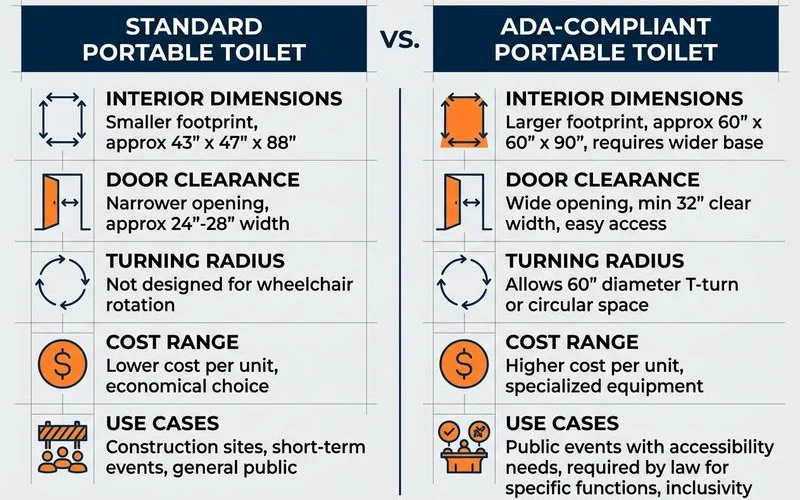
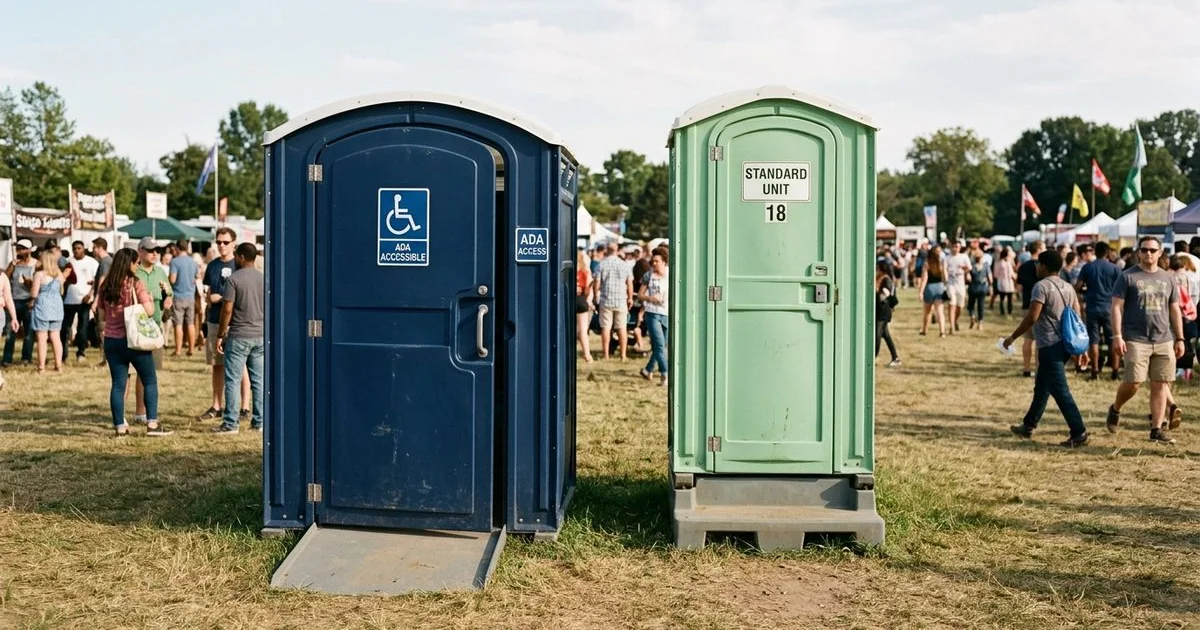
The most visible difference between these units is the interior space and the doorway width. Standard units offer about 13 square feet of floor space, while ADA models provide roughly 30 square feet.
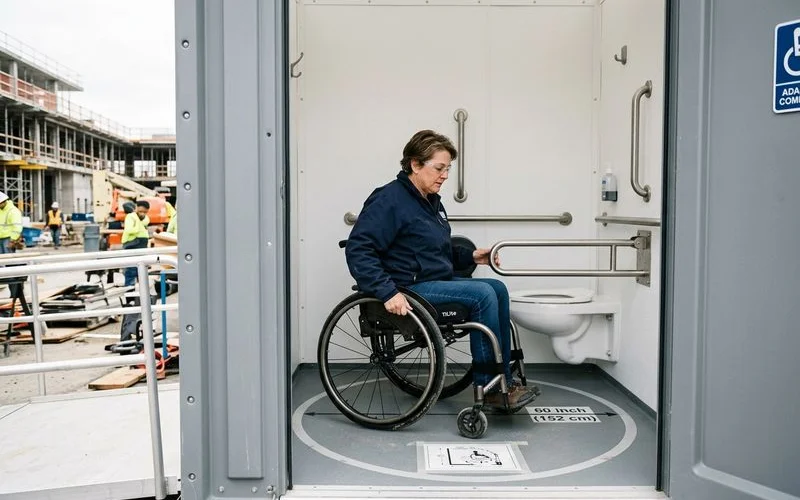
We often use industry-standard models like the Satellite Industries Liberty to show this contrast. The larger footprint is entirely driven by the strict 60-inch interior turning radius required for wheelchair maneuvering.
This extra room ensures users with mobility devices can comfortably enter, turn, and exit.
| Dimension | Standard Porta Potty | ADA Portable Toilet |
|---|---|---|
| Exterior Dimensions (W x D x H) | 43” x 47” x 90” | 62” x 62” x 90” |
| Interior Floor Space | ~13 square feet | ~30 square feet |
| Door Width | 22-24 inches | 32-36 inches |
| Entry Style | 4-6 inch step up | Flat ground-level floor |
| Turning Radius | N/A | 60 inches (compliant) |
Feature comparison
The standard build focuses on high-volume durability, whereas the ADA unit is engineered specifically around strict accessibility specifications. You will notice key differences in the seating height and door mechanisms.
Our standard units are the workhorses of the construction industry. They are designed to be compact and easy to transport in large numbers.
Standard Unit Features
- Single 60 to 70-gallon chemical waste tank
- Standard-height plastic seat
- Door-mounted toilet paper dispenser
- Locking door latch with standard ventilation
- Optional hand sanitizer dispenser
An accessible model includes specialized safety hardware that meets ANSI A117.1 standards. The lower seat height and reinforced grab bars are critical for user safety.
ADA Unit Features
- Single 35-gallon low-profile chemical tank
- Seat height of 17 to 19 inches (ANSI-compliant)
- Interior grab bars mounted at safe heights
- Wide-clearance door with a pneumatic closer
- Magnetic doors for easier closing unassisted
Cost comparison
A standard porta potty rental in 2026 averages $125 to $275 per month for construction sites, depending on your US region. ADA portable toilets for the same cycle generally cost 50% to 80% more.
Our pricing models reflect the larger footprint and specialized transport required for accessible units. Event pricing for weekend rentals follows a similar percentage spread.
The price spread sounds significant in percentage terms but is small in absolute dollars.
| Unit Type | Average Weekly Cost (2026) | Average Monthly Cost (2026) |
|---|---|---|
| Standard Unit | $135 - $195 | $125 - $275 |
| ADA-Compliant Unit | $200 - $300 | $225 - $450 |
For an event ordering 20 standard units plus one ADA unit, the accessible addition adds perhaps $50 to $150 to the total order. Compare that to a potential OSHA non-compliance fine, which can reach up to $16,550 per violation.
We always advise clients that the math is straightforward. The small upfront cost of compliance far outweighs the risk of severe financial penalties.
When ADA is required vs optional
Any event or site classified as a public accommodation under ADA Title III rules must provide accessible restrooms. Private worksites closed to the general public have more flexibility.
Our legal experts advise clients that Title III requires at least 5 percent of single-user portable toilets at a single location to be ADA-compliant. The rules are very clear on where these units must be deployed.
Required Placements
- Any public event requiring a wheelchair accessible porta potty under ADA Title III rules
- Construction projects open to the public during work
- Municipal and public works projects
- Ticketed weddings at public-accommodation venues
- Festivals and large outdoor events
Certain situations do not legally require full compliance, but providing accessible options is still highly encouraged for guest comfort.
Optional Placements (But Recommended)
- Private weddings on private property
- Worksites strictly closed to the public
- Internal corporate events with no public access
When in doubt, plan for full accessibility. The legal exposure of guessing wrong is simply too high.
Mixed-fleet recommendations
The ideal setup combines a large volume of standard units with strategically placed ADA models to handle peak crowds safely. The starting answer for most public-accommodation work is a 5 percent ADA mix on top of the standard unit count.
Our event planners rely on a specific deployment strategy to handle mixed fleets efficiently. This ensures compliance without sacrificing general admission capacity.
Standard Deployment Strategies
- General Admission: 95 percent standard porta potties
- Accessibility: 5 percent ADA units distributed evenly across cluster locations
- Premium Upgrades: Pair a restroom trailer with a standalone ADA unit
- Construction Rule (No Flush): One standard unit per 10 workers (OSHA 29 CFR 1926.51)
- Construction Rule (Flush): One standard unit per 20 workers
Site managers must strictly follow the public-accommodation rule for accessible add-ons whenever the job site remains open to the public. For more detail on sizing ADA inventory for your event, see the dedicated guide.
Decision summary
The decision rarely comes down to a simple choice of one unit type over another. It is entirely about calculating the right mix for your specific footprint and attendee count.
Our starting answer for most public-accommodation work is a 5 percent ADA ratio on top of the standard porta potty count. That ratio adjusts based on event type, alcohol service, and placement requirements.
A dedicated commercial rep will size the ada vs standard portable toilet mix based on your exact site details. Contact us today to secure compliance documentation suitable for local permit reviewers and finalize your ada porta potty vs standard requirements.