Understanding exactly what is a shower trailer rental is critical for job site planning. We know that this foundational element directly impacts crew morale and project compliance.
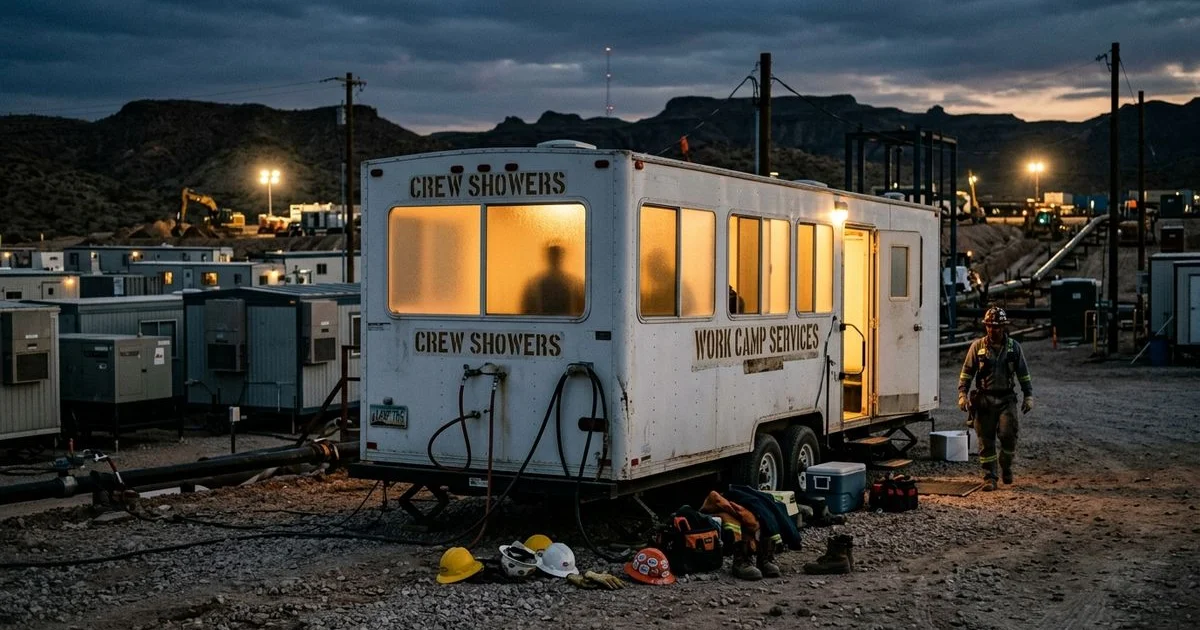
A standard shower trailer rental operates as a self-contained, multi-stall mobile facility that delivers hot showers in environments without permanent plumbing. Our team sees disaster relief staging, remote work camps, and multi-day festivals requiring people to get clean every day when no building exists to support it. Site managers rely on these units to maintain hygiene without permanent infrastructure.
The mobile shower unit explained below provides the exact specifications you need to plan your next site.
Multi-stall layout with private changing
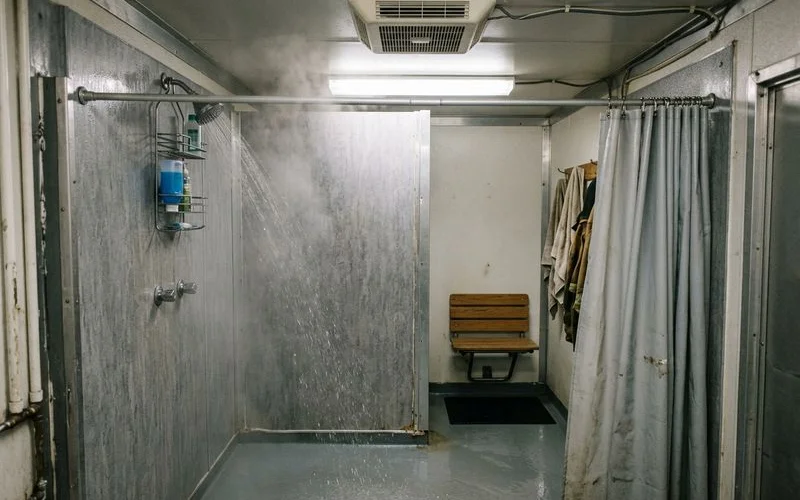
The inside of a shower trailer is laid out for maximum privacy and turnaround speed. Our stalls function as completely self-contained modules designed to handle high-volume use.
Facilities must meet strict sanitation standards, including guidelines set by the Occupational Safety and Health Administration. The OSHA 1910.141 standard requires at least one shower for every 10 employees exposed to specific hazardous materials.
We build these interiors with a standardized setup to ensure safety and comfort:
- A curtained or fully enclosed shower area
- A private changing space with a bench seat and clothing hooks
- A vanity mirror positioned at eye level
- Slip-resistant flooring throughout the compartment
- Adequate ventilation to prevent steam buildup and mold
Larger trailers arrange these stalls in rows along both sides of a central corridor. Smaller configurations feature a single corridor with four to six individual rooms.
Our standard layouts typically split men’s and women’s sides on opposite ends of the unit. Some work camps use a flexible designation, assigning all-male shifts in the morning and all-female shifts in the evening.
Gas vs electric water heating
The water heater is the most important specification to get right when determining shower trailer rental basics. You must choose between a fast-recovery gas heater or a clean-setup electric model based on your daily user volume.
We recommend analyzing your peak-use patterns before selecting a power source. High-capacity tankless propane water heaters, pushing up to 136,000 BTUs, deliver flow rates exceeding five gallons per minute.
This rapid recovery is essential for multi-day festivals or large construction sites. A correctly sized gas heater on an eight-stall trailer typically supports four to six consecutive showers per stall before requiring a short recovery cycle.
Our electric heating option provides a simpler setup with no fuel handling required. These systems run on a standard 110v hookup or a portable generator.
| Feature | Gas Heating (Propane/Natural Gas) | Electric Heating |
|---|---|---|
| Best For | High-throughput (work camps, festivals) | Moderate-throughput (event-side) |
| Power Source | Propane tank or natural gas hookup | Standard 110v hookup or generator |
| Recovery Speed | Very fast (Up to 5+ GPM flow rate) | Slower (Longer wait times) |
| Fuel Handling | Requires secure fuel storage | Clean setup with no fuel required |
Wait times between consecutive showers increase slightly with electric units due to slower recovery rates. We schedule the heater around your peak-use patterns during 24-hour deployments. Morning and post-shift routines receive priority to prevent recovery cycles from disrupting the schedule.
Soap, towel dispensers, and vanity mirrors
Each stall comes fully equipped with essential built-in amenities to speed up turnaround times:
- Liquid soap dispenser (refilled by the service team)
- Heavy-duty paper towel dispenser
- Shatter-resistant vanity mirror
- Secure hooks for clothing and towels
These fixtures ensure basic hygiene without requiring users to carry supplies through the site.
We recognize that adhering to Centers for Disease Control (CDC) guidelines is critical for community evacuation centers. Proper handwashing stations within the stalls limit disease transmission during disaster response scenarios.
Cloth towels generally remain the renter’s responsibility for remote camps where guest-supplied linens prove impractical. Our service team restocks soap and paper towels on a predictable cycle based on your contract:
- Active deployments: Restocked every two to three days for work camps.
- Moderate use: Replenished on a weekly schedule for smaller events.
These scheduled visits ensure your team never runs out of basic supplies.
Freshwater tank or hookup
Three primary water-supply configurations power these units, including grid hookups, onboard freshwater tanks, and hybrid setups. Your location’s existing infrastructure determines which method will supply the daily water volume.
We install EPA WaterSense certified low-flow showerheads that consume 2.0 gallons per minute or less. This efficiency extends the life of onboard resources without sacrificing water pressure for the user.
A standard 300-gallon onboard tank easily supports dozens of showers before requiring a scheduled refill. Our inventory offers three primary setup choices:
- Grid hookup: Uses a standard garden hose connection from a municipal water source, common at established event venues.
- Onboard freshwater tank: Ships with a 100 to 300-gallon tank for grid-free deployments, requiring scheduled refills.
- Combination: Plugs into grid water while keeping the onboard tank ready as a backup during outages.
Disaster relief sites and remote construction camps rely almost exclusively on the onboard tank configuration. We size the onboard tank based on your deployment’s daily shower count and refill access. This calculation guarantees you have enough water to handle peak morning and evening rushes.
Greywater capture and disposal
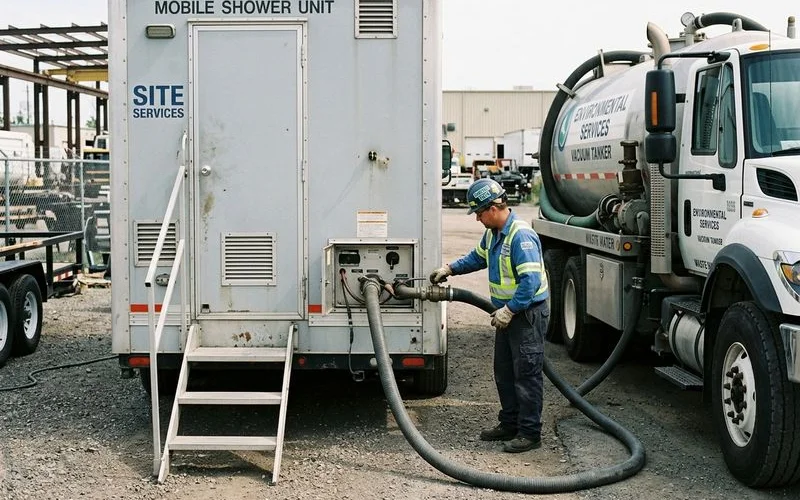
All shower water drains directly into the trailer’s onboard greywater holding tank for safe storage. Environmental Protection Agency regulations prohibit discharging untreated greywater onto the ground at commercial job sites.
We safely pump this wastewater into heavy-duty vacuum trucks and transport it to a permitted disposal facility. Commercial vacuum trucks, such as the Mack MD7 models, feature a 2,500-gallon capacity to handle massive volumes of liquid waste quickly.
The size of the greywater tank correlates directly with the unit’s freshwater capacity. Our pumping frequency schedule depends entirely on your daily use volume:
- High-use: Daily or every two days for disaster staging and work camps.
- Moderate-use: Every two to three days for multi-day festivals.
- Light use: Once per service cycle, typically weekly, for smaller event-side deployments.
Site managers coordinate with us to set the pumping schedule at the start of the deployment based on expected capacity. We use this proactive planning to prevent overflows and keep the facilities operational around the clock. You never have to worry about managing the disposal logistics yourself.
Average dimensions
Trailer dimensions vary significantly based on the total stall count and onboard water storage requirements. Site managers must account for both the physical footprint and the necessary clearance for service access.
We comply with the Department of Transportation (DOT) National Network limits, which cap standard trailer widths at 102 inches, or 8.5 feet. This legal width allows units to travel smoothly on major highways without requiring special oversized permits.
Approximate physical dimensions include:
| Trailer Size | Length | Width |
|---|---|---|
| 4-stall compact | 16 to 20 feet | 8 feet |
| 8-stall standard | 28 to 36 feet | 8.5 feet |
| 12+ stall large | 40 to 48+ feet | 8.5 feet |
Our installation process adds four to six feet on each side for stabilizing jacks and entry steps. Power and water hookup access requires an additional 10 feet of clearance at the rear or side.
We evaluate your event placement to ensure the ground is firm enough to prevent the stabilizing jacks from sinking. The delivery tow vehicle requires standard tractor-trailer access to maneuver the unit into position safely.
Common use scenarios
Mobile showers support operations ranging from emergency disaster relief zones to long-term military training exercises. The core sizing questions always revolve around daily user volume, peak demand concentration, and deployment duration.
We frequently ship trailers directly to Federal Emergency Management Agency (FEMA) staging areas during the active hurricane season. These rapid-response deployments provide critical hygiene infrastructure for both displaced residents and incoming first responders.
The most common deployments include:
- Disaster relief: FEMA staging areas, post-storm response, and wildfire base camps.
- Remote work camps: Oil and gas extraction, pipeline construction, and mining sites.
- Multi-day festivals: Music festivals, regional fairs, and outdoor sporting events.
- Military training: Field operations and multi-week deployments at improvised bases.
Our dedicated commercial representatives analyze your specific timeline and headcount to size the order accurately. This data-driven approach prevents you from overpaying for unnecessary capacity or dealing with excessive wait times.
Pricing summary
Weekly rental prices scale based on the stall count, heater configuration, and total deployment duration. In 2026, single-stall and 4-stall trailers start around $1,500 per week, while premium multi-stall event units average $1,999 to $2,499 per weekend.
We utilize transparent unit rates for long-term multi-week deployments and government disaster contracts. Custom quotes are free and built within hours to help you finalize your project budget quickly.
Final pricing adjustments depend heavily on the following variables:
- Generator and onboard freshwater add-ons
- Delivery distance from the regional holding yard
- Total frequency of required pumping and restocking services
Our billing process ensures you see exactly what each line item costs before signing the agreement. Understanding exactly what is a shower trailer rental when reviewing costs keeps the final invoice predictable and fair.
Conclusion
Securing the right sanitation facilities protects your crew’s health and keeps your project moving forward without delays. Knowing the specifics of what is a shower trailer rental allows you to plan your site layout and budget accurately.
We are ready to help you size the perfect unit for your upcoming 2026 deployment.
Contact the commercial team today to receive a free, customized quote mapped to your exact specifications.